.png)
What RCS Means for the Future of Business Messaging
- ongpohlee99
- 2 days ago
- 4 min read
Business messaging is moving beyond plain text. For years, SMS has been useful because it is simple, direct, and widely understood. But it also has clear limits. It cannot create rich product experiences, it gives brands very little visual identity, and it often leaves users with a flat message that feels detached from the rest of the customer journey.
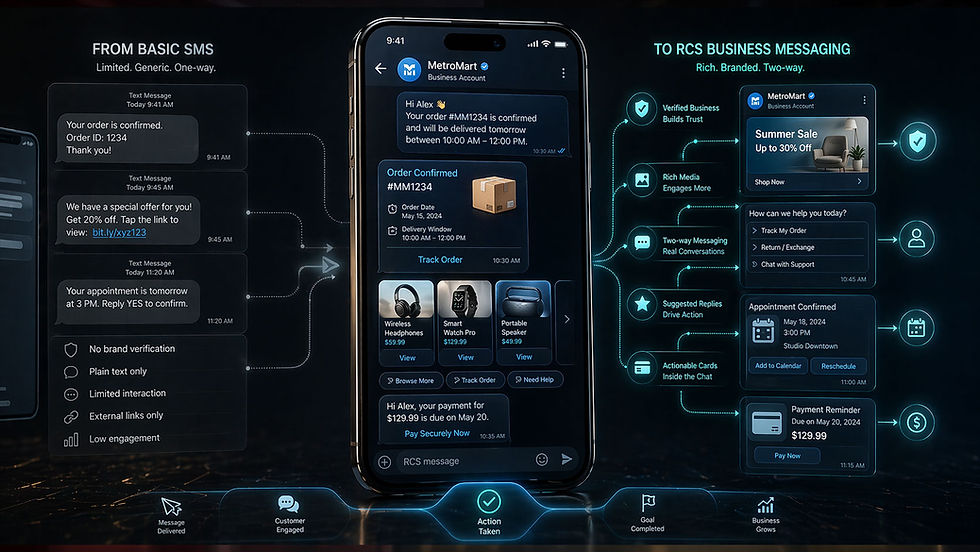
RCS, or Rich Communication Services, changes that direction. It brings richer, more interactive messaging into the phone’s native messaging app, allowing businesses to use branded sender profiles, media, rich cards, suggested replies, and clearer action paths. Google describes RCS for Business as a way to bring branded, interactive mobile experiences into the default messaging app.
RCS Makes Business Messages Feel Less Like Plain Notifications
Traditional SMS often feels like a short alert. It can remind users, confirm something, or push a link, but the experience is limited. RCS gives businesses more room to communicate with context.
Instead of sending only a short line of text, a business can present richer information inside the message itself. Google’s RCS rich cards can include media, title text, descriptions, and suggested replies or actions.
This matters because users no longer need to interpret a message and then decide what to do from scratch. The message can guide them more clearly.
Verified Brand Identity Becomes More Important
One of the biggest future shifts is trust. In normal SMS, users often see unfamiliar numbers, shortcodes, or sender names that may not feel fully reliable. That creates hesitation, especially when the message asks the user to click, confirm, or respond.
RCS Business Messaging helps solve part of that by allowing verified sender profiles with brand names, logos, colours, and recognisable identity cues. Google’s RCS for Business highlights verified sender profiles as a way to make brands easier to recognise.
For businesses, this means messaging will become less about “sending from a number” and more about showing up as a trusted brand inside the inbox.
The Inbox Becomes a Conversion Space
RCS also changes the role of the messaging inbox. Instead of using messages only to push users elsewhere, businesses can create a more complete interaction inside the message thread.
This could affect:
appointment confirmations
product discovery
payment reminders
order updates
lead qualification
customer support flows
promotional campaigns
The future of business messaging will not only be about sending more messages. It will be about making each message more useful, more actionable, and less dependent on users jumping across multiple platforms.
RCS Reduces the Gap Between Message and Action
A common weakness in business messaging is the gap between interest and action. A user receives a message, clicks a link, waits for a page to load, reads again, and then decides what to do. Every step creates friction.
RCS can shorten that path by placing suggested replies, buttons, rich cards, and action prompts directly inside the conversation. That makes the user journey feel more guided.
For businesses, this is valuable because it reduces drop-off caused by uncertainty. For users, it feels easier because the next step is already visible.
It Will Push Brands to Think Beyond Broadcast Messaging
RCS makes weak messaging harder to hide. When businesses gain access to richer formats, plain broadcast-style communication will feel even more limited. A message that simply says “click here” may start to look outdated beside messages that offer clearer choices, stronger visuals, and more helpful interaction.
This means brands will need to think more carefully about message structure. The question will no longer be only, “What do we send?” It will become, “What experience does this message create?”
RCS Will Not Replace Every Channel Immediately
RCS is important, but it will not remove the need for WhatsApp, email, apps, or websites overnight. Business messaging still depends on audience behaviour, device support, market adoption, and the type of journey being built.
SMS will remain useful for simple alerts. WhatsApp will still be strong where conversation and community habits already exist. Apps will still matter for deeper account-based experiences.
The real future is not one channel replacing everything. It is businesses choosing the right channel for the right kind of interaction.
The Biggest Opportunity Is Better Customer Flow
The strongest value of RCS is not just that messages look better. It is that the customer journey can become smoother.
A well-built RCS message can show the brand clearly, explain the offer better, guide the next action, and reduce unnecessary back-and-forth. That makes business messaging feel less like a one-way blast and more like a structured interaction.
For businesses that rely on mobile communication, this is where RCS becomes strategically important.
Final Thoughts
RCS means business messaging is becoming more visual, branded, interactive, and action-focused. It moves messaging closer to an app-like experience without always requiring users to download another app.
For the future, this means stronger trust signals, clearer customer journeys, and more useful message experiences. Businesses that treat RCS as just “better SMS” may underuse it. The real opportunity is to use it as a bridge between communication and conversion.


Comments