.png)
Why Some WhatsApp Blasts Create Support Overload
- ongpohlee99
- Jan 19
- 4 min read
When WhatsApp Blasts Trigger Unexpected Demand
Many organisations launch WhatsApp blasts expecting visibility, awareness, or simple engagement. What they often get instead is something far more intense: an immediate flood of replies hitting the support inbox within minutes. Teams that were operating smoothly suddenly find themselves overwhelmed, responding to similar questions repeatedly and struggling to keep up.

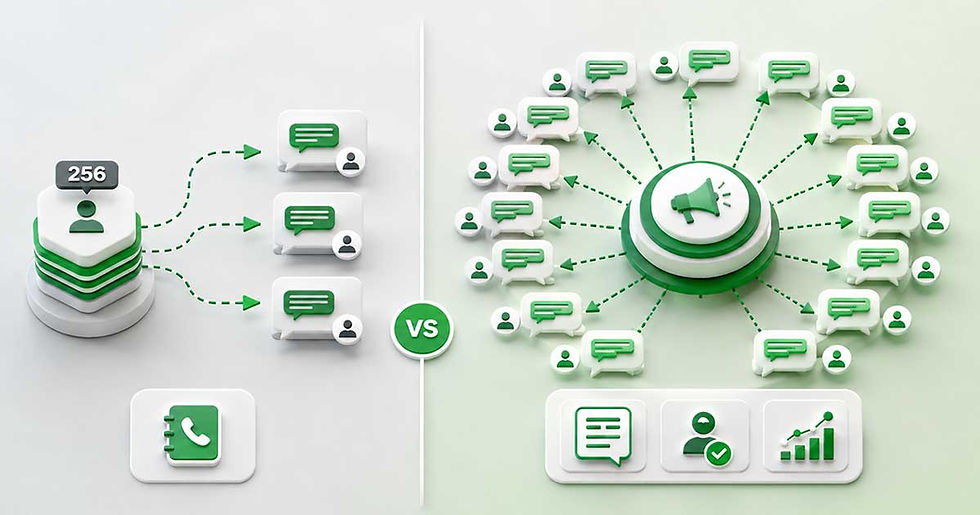
This scenario is not a system failure, nor is it a breakdown in customer behaviour. WhatsApp blasting functions as a demand amplifier, not just a broadcast channel. When messages are delivered directly into a personal, conversational space, they naturally invite response. Support overload is therefore an operational outcome of how WhatsApp works—not a technical malfunction or a mistake by frontline teams.
Message Framing That Encourages Immediate Replies
One of the strongest drivers of support overload is how messages are written. Campaigns that include urgency cues such as “limited time,” “reply now,” or “don’t miss out” reliably trigger instant reactions. Open-ended phrasing like “message us to learn more” or “reply for details” funnels curiosity straight into the support queue.
From a behavioural standpoint, this is entirely predictable. WhatsApp is perceived as a real-time channel. When users see an urgent message in a chat interface, they respond as if they are entering a live conversation. This is not misuse of the platform—it is users behaving exactly as the channel encourages them to behave.
WhatsApp Read Indicators and False Urgency
Read indicators introduce another layer of pressure. When users see messages marked as delivered or read, expectations shift immediately. Many assume that a read message means someone is actively available to respond.
Technically, read receipts only confirm message visibility on a device. They do not indicate agent availability, queue length, or response priority. However, psychologically, these indicators create a sense of immediacy. Users feel justified in expecting fast replies, which compounds support pressure even when staffing levels have not changed.
Call-to-Action Design That Routes Everything to Support
Support overload often originates at the call-to-action level. Campaigns that funnel all responses into a single inbox—without differentiation—force human agents to handle every inquiry, regardless of complexity.
When every reply routes to the same place, simple questions, repetitive clarifications, and complex cases all compete for attention. This is not a staffing issue. It is a design issue. Single-path CTAs create unnecessary congestion and remove opportunities for self-resolution or automated handling before human intervention is required.
Automation Gaps Between Blasts and Support Systems
Another common contributor is the lack of automation between outbound campaigns and inbound support workflows. Agents end up manually answering the same questions over and over because there is no routing logic, tagging system, or automated first response in place.
Without pre-response filtering, even basic inquiries require human handling. Over time, this creates fatigue and inefficiency. The overload does not stem from agent performance—it stems from missing system integration between marketing actions and support operations.
Timing Effects on WhatsApp Blast Response Volume
Timing plays a critical role in how intense the response surge becomes. Messages sent during evenings, weekends, or lunch hours tend to generate clustered replies within a short time frame.
This happens because user availability overlaps. Large numbers of recipients read and respond simultaneously, creating a burst-response pattern. The intent of users does not change, but the synchronisation of their behaviour amplifies the load placed on support teams at specific moments.
Mismatch Between Broadcast Scale and Support Capacity
A fundamental planning gap often sits at the centre of overload: outbound scale grows faster than inbound capacity. A single blast can reach thousands of users instantly, but support teams scale linearly, not exponentially.
When this imbalance is not accounted for, even well-trained teams become overwhelmed. This is not a failure of staff or an unreasonable expectation from users. It is a mismatch between reach and readiness that must be addressed at the planning stage, not after overload occurs.
Repetitive Questions That Multiply Workload
Support agents frequently report that overload feels worse because of repetition. The same questions appear again and again: pricing, eligibility, steps, or basic clarifications.
This repetition usually signals that key information was missing or unclear in the original message. When campaigns leave gaps, users naturally fill them by asking. Each missing detail multiplies workload downstream. The issue is not that users ask too much—it is that campaigns sometimes explain too little.
Why Support Overload Feels Sudden
One of the most challenging aspects of WhatsApp blast overload is how abruptly it arrives. Teams may feel blindsided, even if campaigns were planned weeks in advance.
This is because WhatsApp responses behave differently from email or social channels. Instead of gradual engagement, WhatsApp produces rapid bursts. Once the blast lands, responses cluster tightly in time. Overload feels sudden because the trigger-response loop is short and intense, but it follows consistent and identifiable patterns.
Conclusion — Managing Demand, Not Silencing Users
Support overload caused by WhatsApp blasting is not a reason to restrict communication or silence users. It is a signal that demand is being generated faster than it is being managed.
Sustainable WhatsApp blasting depends on alignment—between message framing, call-to-action design, automation, timing, and support capacity. When these elements work together, demand becomes manageable rather than overwhelming. The goal is not fewer replies, but better-prepared systems that can handle them effectively.


Comments