.png)
What Are WhatsApp Business Broadcasts and How Are They Different From Old Broadcast Lists?
- ongpohlee99
- 2 days ago
- 6 min read
"WhatsApp broadcast" has quietly become two different things — and confusing them is one of the most common mistakes in WhatsApp marketing. There's the old, familiar broadcast list built into the free WhatsApp Business app, and there are business broadcasts sent through the WhatsApp Business Platform (the API). They sound the same and do superficially similar things, but they differ in scale, reach, cost, and capability in ways that matter a lot for how you actually message customers. Let's clear it up: what each one is, how they differ, and which fits what.
First, what a broadcast actually is
Ground the shared idea before the differences.
Both kinds of broadcast rest on the same core mechanic, and it's a genuinely useful one. <cite index="5-1">A WhatsApp broadcast lets you send the same message to many contacts at once, while each recipient sees it as a normal private chat. No one sees the other recipients, and anyone can reply directly to you.</cite> That single detail — one message, many private one-to-one chats — is what makes a broadcast feel personal rather than like a group blast, and it's true of both the old lists and the newer business broadcasts.
So a "broadcast" is not a group and not a channel. It's a private one-to-many send. The confusion starts because, as the sources put it, <cite index="5-1">"WhatsApp broadcast" means two different things.</cite> Let's take each.
The old way: broadcast lists in the WhatsApp Business app
Here's the familiar one, still around and still useful for the right case.
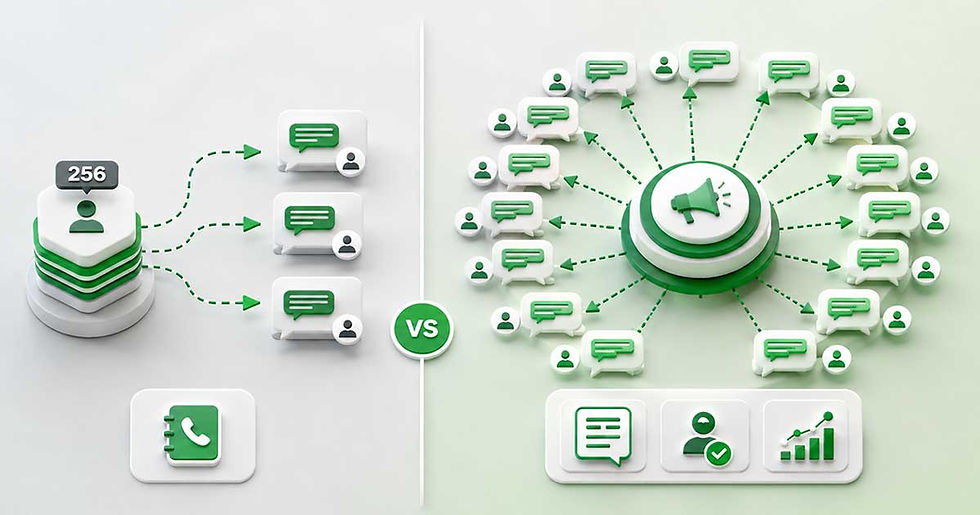
The broadcast list is built into the free WhatsApp Business app. But it comes with two defining limitations. First, scale: <cite index="2-1">WhatsApp broadcast lists still work inside the free WhatsApp Business app — but capped at 256 contacts per list.</cite> Second, and more restrictive, reach: they <cite index="2-1">only reach people who have saved</cite> your number in their phone.
That second point is the big catch. A broadcast list can only deliver to people who have already added your number to their contacts. If a customer hasn't saved you, they simply won't get the message. On top of that, the old lists offer little in the way of data — <cite index="6-1">broadcast lists have important limitations that many are unaware of: a maximum of 256 contacts per list, the requirement that recipients have you saved in their contacts, and the absence of detailed open or delivery metrics.</cite>
So the old broadcast list is free, simple, and private — but small, dependent on customers having saved you, and largely blind on results. For a small business with a modest, engaged contact list who've all saved the number, that can be perfectly fine.
The newer way: business broadcasts through the Platform (API)
Now the version that removes those constraints — at the cost of more setup and rules.
A business broadcast through the WhatsApp Business Platform is the "professional" version. It lifts the core limitations of the old lists. On scale, <cite index="3-1">the free WhatsApp app limit is 256 contacts per list; the Business API removes this cap.</cite> And on reach, it doesn't require customers to have saved your number: <cite index="6-1">with the API, messages arrive even if the recipient doesn't have your number saved (always with prior opt-in).</cite>
It also adds the capabilities the old lists lack. With the API you get <cite index="6-1">Meta-approved templates: professional message templates with interactive buttons, images, and personalized variables; detailed metrics so you know exactly who received, read, and responded; complete automation with CRM integration for dynamic segmentation; and AI agents that can manage the conversation if a recipient responds.</cite> One source captures the leap well: the difference <cite index="6-1">is like the difference between sending emails one by one from Gmail and using an email marketing platform.</cite>
So business broadcasts give you scale, reach beyond saved contacts, personalization, templates, and real analytics. But — and this is the honest part — that power comes with rules.
The honest trade-offs of business broadcasts
Business broadcasts aren't just "the same but bigger." They operate under a stricter, paid framework, and you should go in knowing it.
Opt-in is required. You can reach people who haven't saved your number, but only if they've agreed to hear from you: <cite index="6-1">messages arrive even if the recipient doesn't have your number saved — always with prior opt-in.</cite>
Templates need approval. Marketing broadcasts run on pre-approved templates — <cite index="2-1">marketing template messages must be pre-approved by Meta before you can send a broadcast through the API.</cite>
It's priced per conversation, and there are caps. Broadcasting in 2026 involves, as one source lists, <cite index="2-1">four hard limits — a contact cap, a daily marketing cap, opt-in, and template approval — and a pricing system that bills per conversation, not per message.</cite>
The 24-hour window matters. After a broadcast lands, <cite index="2-1">you have a 24-hour window where any reply opens a free-form conversation; outside that window, every reply needs a fresh template.</cite>
So the newer broadcasts trade the old lists' simplicity and zero cost for scale and capability — under opt-in, template, cap, and pricing rules.
An honest word on open rates
One myth worth puncturing, because it's everywhere.
You'll see "95-98% open rates" quoted constantly for WhatsApp broadcasts. Treat that with caution. A more measured figure, per honest reporting, is that <cite index="5-1">the measured open rate is around 60 to 68 percent, not the "98 percent" you see quoted everywhere — and still far ahead of email,</cite> with WhatsApp typically delivering several times the engagement of email even at conservative benchmarks. So broadcasts genuinely are a high-engagement channel — just don't plan around the inflated numbers.
So which should you use?
The honest answer depends on your size and needs — and the sources are refreshingly clear about it.
If you're a small business with a limited, engaged audience who've saved your number, the free broadcast list may be all you need: <cite index="1-1">if your audience is small and already has your number saved, a broadcast list works.</cite> The broader framing: <cite index="1-1">the WhatsApp Business App is better suited for small businesses handling limited customer communication manually, while the API is designed for medium to large businesses that want to automate, scale, and optimize.</cite>
The practical triggers to move up to business broadcasts, per the guidance, are clear: <cite index="7-1">switch to API broadcasts when you need to send to more than 256 contacts in one campaign, want to personalize with name or order details, or need reports on who received, read, and replied.</cite> Until you hit those, the free list may serve fine.
The thing both versions share — and the thing that actually matters
Whichever you use, one truth sits underneath both.
A broadcast — old list or new business broadcast — is only the opening. As the reporting bluntly puts it, <cite index="2-1">the DM you send is not the campaign; the campaign is the conversation the broadcast starts.</cite> The mechanics, limits, and pricing all matter, but they're plumbing. What determines whether a broadcast works is the same as it's always been: whether people opted in, whether the message is relevant and welcome, and whether you handle the reply well. A bigger, fancier broadcast delivered to people who don't want it still fails; a humble broadcast list message to an engaged, consenting audience can succeed handsomely.
So understand the difference — old lists are small, free, and limited to people who saved you; business broadcasts scale, reach opted-in non-savers, personalize, and measure, under opt-in, template, cap, and pricing rules — and pick the one that fits your size. Then put your real energy into sending welcome, relevant messages and handling the conversations they start. That's the part no upgrade changes.
Frequently asked questions
What's the difference between a WhatsApp broadcast list and a business broadcast?
A broadcast list is the free WhatsApp Business app feature, capped at 256 contacts and only reaching people who've saved your number, with no detailed metrics. A business broadcast through the WhatsApp Business Platform (API) removes the 256 cap, reaches opted-in people even if they haven't saved your number, and adds approved templates, personalization, and analytics — but requires opt-in, template approval, and per-conversation pricing.
Do broadcasts work like group chats?
No. Both kinds of broadcast send the same message to many people, but each recipient receives it as a private one-to-one chat. No one sees the other recipients, and replies come only to you. That privacy is what makes broadcasts feel personal rather than like a group blast, and it distinguishes them from WhatsApp groups.
Why can't my broadcast list reach some contacts?
Because a broadcast list in the free app only delivers to people who have saved your number in their contacts. If a customer hasn't added your number, they won't receive your broadcast-list message. Business broadcasts through the API remove this requirement, reaching opted-in recipients even if they haven't saved your number.
When should a business upgrade to API broadcasts?
When you need to send to more than 256 contacts in one campaign, want to personalize messages with details like name or order number, or need reports on who received, read, and replied. Until you hit those needs, the free broadcast list may serve a small, engaged audience perfectly well.
Are WhatsApp broadcast open rates really 95-98%?
Be cautious of that figure. A more measured, honest open rate is around 60 to 68 percent — still far ahead of email and a genuinely high-engagement channel, but not the inflated "98 percent" widely quoted. Plan around realistic numbers rather than the marketing hype.

Comments